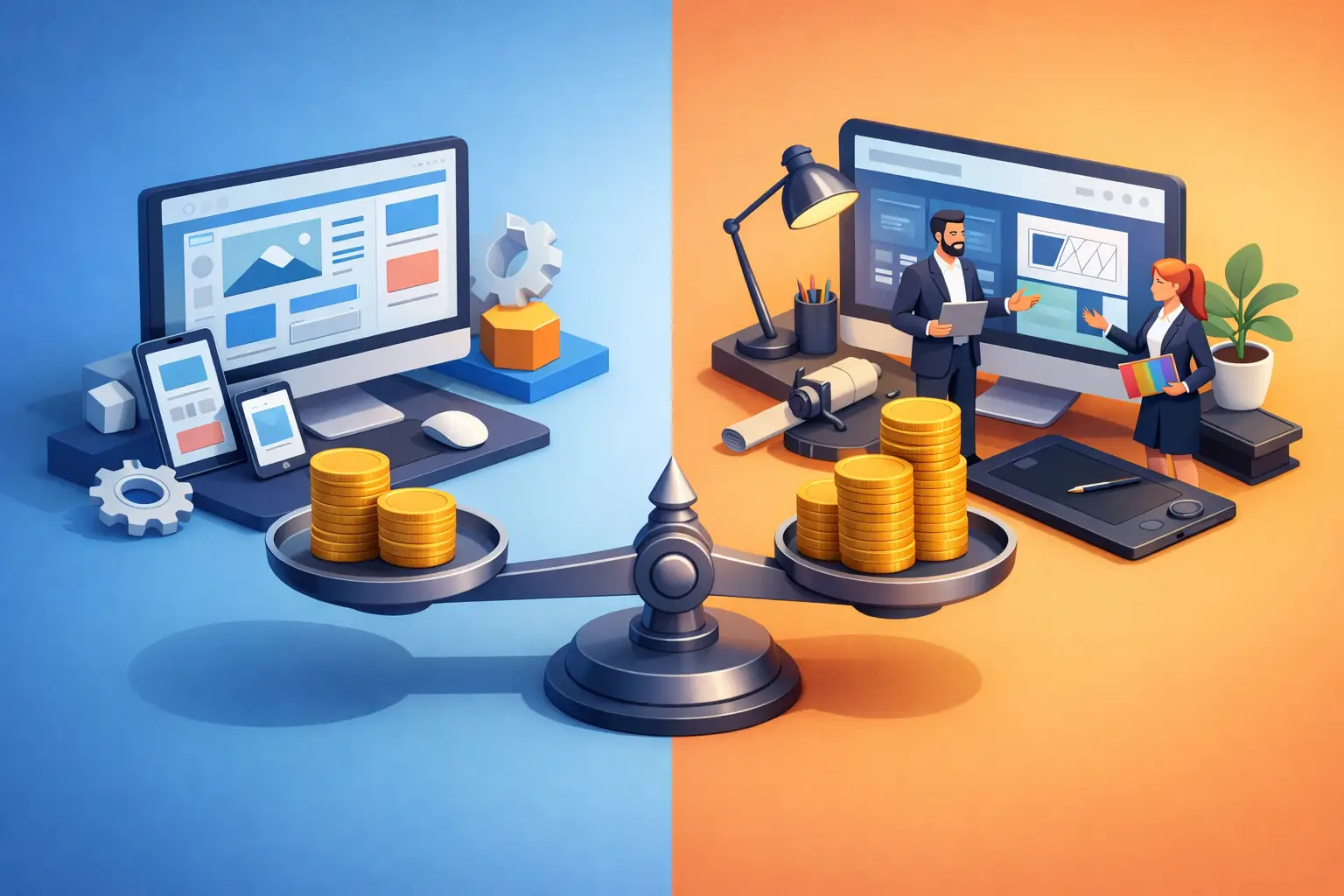
A $500 website and a $15,000 website can both go live this week. That is what makes the website builder vs agency cost question tricky for small businesses. The price gap is real, but so is the gap in process, speed, control, and what you are actually buying.
If you need a site fast, the cheapest option is not always the smartest one, and the most expensive option is not always the best fit. A local service business, solo consultant, startup founder, or marketer launching a campaign usually does not need the same website setup as a funded company planning a full custom platform. The right choice depends less on hype and more on what has to happen after the site goes live.
Website builder vs agency cost: the real difference
At the surface level, a website builder looks dramatically cheaper. Most builders charge a monthly subscription, often somewhere between $10 and $100 depending on features, hosting, custom domain support, forms, analytics, and ecommerce tools. Even with premium add-ons, the upfront cost usually stays low.
An agency works differently. Instead of paying mainly for software, you are paying for strategy, project management, design, development, revisions, copy coordination, QA, and launch support. A basic small business site from an agency might start around $2,000 to $5,000. More customized builds regularly land in the $8,000 to $25,000 range, and larger projects can go much higher.
That does not mean agencies are overpriced or builders are limited by default. It means they solve different problems. A website builder gives you a faster path to a working site. An agency gives you a service model with more hands involved and, usually, more customization.
The cost question gets clearer when you stop asking, “What does a website cost?” and start asking, “What outcome am I paying for?”
What you are paying for with a website builder
A builder is usually the better fit when speed matters, your requirements are clear, and you do not want a long production cycle. You are paying for software that reduces the amount of human labor needed to launch.
That matters more than most business owners expect. Traditional site creation often stalls because someone has to write a brief, wait for mockups, review revisions, request changes, approve copy, and coordinate launch tasks. A builder cuts through that. You provide direction, generate the page, edit what you need, and publish.
For a lot of businesses, that is enough. A dentist who needs a clean local practice site, a lawyer launching a service page, or a consultant building a lead capture page does not always need a custom design system or a multi-week discovery phase. They need something polished, live, and editable.
That is where AI-driven tools have changed the equation. Instead of spending hours inside a template editor, you can describe what you want and get a usable starting point immediately. That reduces not just cost, but friction. For many small businesses, friction is the hidden budget killer.
What you are paying for with an agency
An agency becomes more valuable when the project is not just about getting a site online. If you need brand positioning, custom UX, complex integrations, advanced SEO architecture, custom functionality, or a site that must pass through multiple stakeholders, the service layer starts to matter.
You are also paying for judgment. A good agency can help shape messaging, identify gaps, organize content, and prevent expensive mistakes. If your business has a larger sales process, multiple audience segments, strict compliance requirements, or technical dependencies, that guidance can be worth the premium.
But agency pricing often includes more than the finished website. It includes meetings, communication overhead, handoffs, rounds of feedback, and project coordination. Those things can improve quality, but they also increase cost and slow execution.
For some teams, that is a fair trade. For others, it is exactly what they are trying to avoid.
Website builder vs agency cost over time
The upfront number is only part of the story. Long-term cost matters just as much.
A builder usually spreads expense across time. You pay monthly or yearly, and you handle updates yourself. Need to change a headline, launch a seasonal page, or test a new offer? You can do it without opening a new project or paying change-order fees.
An agency often looks more expensive at the start, but the bigger issue can be post-launch dependency. If every update requires a request, quote, and turnaround window, your site becomes harder to operate. That can turn small changes into recurring costs.
This is where control matters. Business owners often think they are paying for a website, when they are actually deciding how independent they want to be after launch. If your business changes often, self-serve editing has real financial value.
A low monthly software fee plus easy edits can outperform a one-time agency build that becomes expensive to maintain. On the other hand, if your site will stay relatively stable and needs to be highly customized from day one, the agency route may still make sense.
Speed has a cost too
A delayed launch is not free.
This part gets overlooked because it does not show up as a line item on an invoice. If your practice, offer, event, or service page is not live, you are losing leads, visibility, and momentum. Waiting four to eight weeks for an agency project may be fine for a brand redesign. It is less fine when you need to start capturing demand now.
This is one reason builders have become more attractive to founders, solo professionals, and marketers. Speed is not just convenience. It is business leverage.
If you can go from idea to live page in minutes, you can test faster, launch faster, and adjust faster. For landing pages and straightforward business sites, that speed often matters more than having every visual detail custom-crafted.
When a builder is usually the smarter financial choice
A website builder is often the better call if your main goal is to launch quickly with a professional result, keep costs predictable, and stay in control of updates. That is especially true if your website is primarily there to explain your services, capture leads, showcase credibility, or support a campaign.
It is also a strong fit if you are still refining your positioning. Paying agency rates before you know which message converts can be expensive guesswork. A builder lets you publish, learn, and improve without turning every change into a project.
For many businesses, this is the practical middle ground: good quality, very fast deployment, and low overhead. That is why AI-first tools such as DevOpser Lite make sense for teams that want a working site without the usual production drag.
When an agency earns the higher price
An agency is easier to justify when your website is central to a larger business system. If you need custom application logic, layered user flows, original branding work, complex third-party integrations, or a site that multiple departments must approve, the higher budget may protect you from bigger problems later.
Agencies can also help if you simply do not have time or internal clarity. If no one on your team can define the sitemap, write the copy, or make decisions, software alone will not fix that. In those cases, paying for expertise and structure can move the project forward.
The key is being honest about complexity. Some businesses buy agency services for simple needs because custom work sounds safer. Others choose the cheapest builder possible for projects that clearly need strategic support. Both decisions can waste money.
How to make the right call
Start with three questions. First, how fast do you need to launch? Second, how often will you need to make changes? Third, is your site mostly informational, or does it require custom functionality and deep strategic input?
If you need something live this week, want direct control, and your requirements are straightforward, a builder will usually give you the best return. If your site is tied to larger brand, technical, or operational demands, an agency may be worth the cost.
The smartest buyers are not asking which option is cheaper in isolation. They are asking which option creates the least waste. Waste can look like overpaying for custom work you did not need. It can also look like choosing a cheap tool that cannot support your actual goals.
A website should not become a long procurement exercise. It should help your business move. Pick the option that gets you to a usable, credible, editable online presence with the least friction, and build from there.