
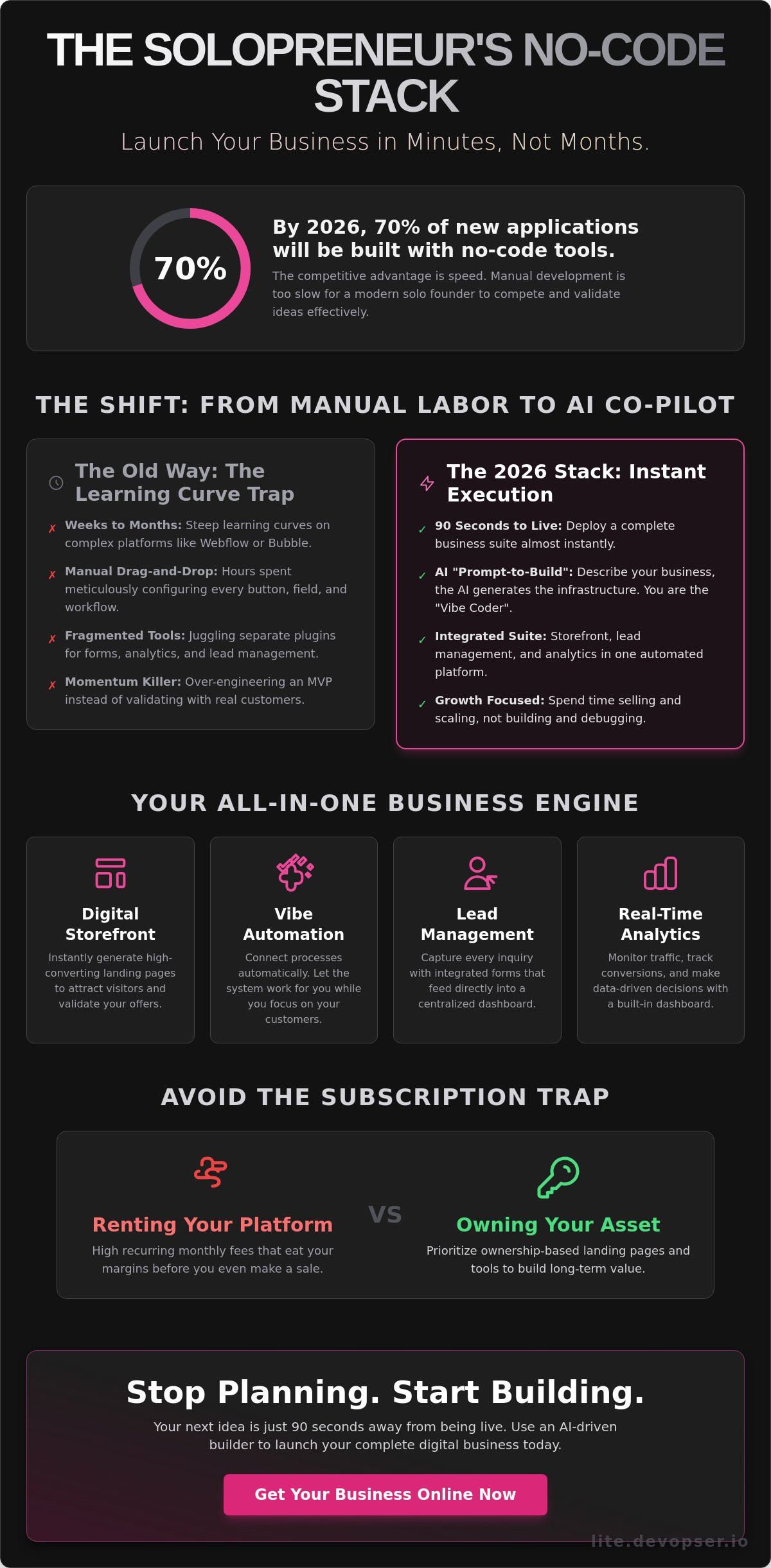
Execution speed defines success for the modern solo founder. Most entrepreneurs waste weeks learning complex platforms or overpaying for basic features. By 2026, Gartner projects that 70% of new applications will be built using no code tools for solopreneurs. You don't need a technical background or a massive budget to join that majority.
It's true that the current market feels crowded and expensive. You're likely tired of steep learning curves and monthly subscriptions that eat your margins before you even launch. This article promises to help you discover the essential no-code stack to launch, manage, and scale your solo business without writing a single line of code.
We'll compare the top platforms for 2026, from automation suites to site builders. Learn how to deploy a free website in 90 seconds and integrate a lead management dashboard that handles the heavy lifting behind the scenes. Stop planning and start building. Get your business online today.
Key Takeaways
- Shift from manual drag-and-drop builders to prompt-to-build workflows for immediate execution.
- Select the right no code tools for solopreneurs to automate lead management without complex plugins.
- Avoid the subscription trap by prioritizing ownership-based landing pages over high recurring costs.
- Deploy a complete digital storefront and business suite in 90 seconds using AI-driven builders.
- Scale operations on autopilot with integrated forms and real-time analytics dashboards.
What Are No-Code Tools for Solopreneurs?
No-code is a visual interface for software development. It removes the technical barrier between a business idea and a live product. Instead of writing complex syntax, you manipulate logic and design through a graphical layer. If you've ever asked what is a no-code platform?, it's a system that translates human intent into machine code automatically. For a solo founder, this means you no longer need to hire a developer to test a market hypothesis or launch a service.
The Evolution of the No-Code Stack
Why Solo Founders Fail with Complex Tools
Many founders fall into the "Learning Curve Trap." They spend weeks mastering platforms like Webflow or Bubble just to launch a simple landing page. This is a mistake. Over-engineering a minimum viable product (MVP) kills momentum. If you spend more time building than selling, your business is at risk. Successful solopreneurs prioritize minimalist tools. Look for systems that offer a setup time of 90 seconds or less. Your goal is a live website and functional forms immediately, not a complex architecture you don't yet need. Don't build for scale until you have customers. Use tools that get you to "live" instantly.
Essential No-Code Categories for Your Business
Research on bootstrapping a no-code startup shows that lean foundations allow for faster pivots. Your infrastructure should support these pivots without requiring a total rebuild. Focus on tools that offer vibe automation and ready-to-use suites. This approach keeps your overhead low and your execution high. It's about building a system that works while you sleep. Avoid fragmented tools that require manual maintenance.
The Front-End: Landing Pages vs. Full Websites
A high-converting landing page is your most valuable asset. Don't build a 10-page website for a product you haven't validated yet. Use AI to generate on-brand copy and visuals instantly. This allows you to test multiple offers in a single afternoon. Ensure your tool supports custom domain integration. A professional URL builds trust immediately. You can launch a professional landing page and see results in minutes rather than weeks. Validation is the only metric that matters at the start.
The Back-End: Lead Tracking and Forms
Top No-Code Tools for Fast Execution in 2026
Speed is the primary metric for solo success. You need a stack that moves as fast as your ideas. The most effective no code tools for solopreneurs in 2026 prioritize immediate output over manual configuration. If you're still asking What Are No-Code Tools, they are the bridge between your vision and a live revenue stream. This selection focuses on tools that deliver results in minutes, not weeks. Your goal isn't to learn a new skill. It's to launch a business.
DevOpser Lite: The 20-Minute Business Launch
Most builders leave you staring at a blank screen. DevOpser Lite uses a prompt-to-business flow to skip the design phase entirely. You describe your offer in plain English. The system generates your landing page, lead management dashboard, and analytics in 90 seconds. It's built on AWS infrastructure. This provides enterprise-grade reliability and speed that generic builders can't match. You get high-performance hosting without the technical setup. The integrated forms work instantly. You don't need to configure plugins or external databases. Simply connect your custom domain and start selling.
Complementary Tools for the Modern Solo Founder
Avoiding the Subscription Trap: Ownership vs. Renting
Solopreneurs often fall into a trap of "death by a thousand cuts." You sign up for a site builder, an automation tool, and a lead tracker. Soon, your monthly overhead exceeds your early profits. This is the subscription trap. Most no code tools for solopreneurs operate on a "rent-to-exist" model. If your credit card fails, your business vanishes. You don't own your infrastructure. You're just a tenant on someone else's platform. This dependency creates a fragile business model where your existence is tied to a vendor's billing cycle. You lose the ability to go dormant during slow periods without losing your entire digital presence.
Contrast this with the ownership model. Paying once or using bundled suites that eliminate recurring fees for basic features is the superior strategy for 2026. Renting platforms like Wix or Squarespace forces you into a recurring billing cycle that never ends. Ownership allows you to focus on growth rather than bills. When you own your assets, your profit margins stay thick. You aren't penalized for scaling or keeping a site live while you pivot. Long-term ROI depends on reducing these fixed costs. Every dollar saved on a subscription is a dollar you can invest in customer acquisition or product development. Successful founders build on foundations they control. Reducing overhead increases your business's resilience against market fluctuations.
Why Pay-Once Models are Winning in 2026
The market has shifted toward one-time payments for core business infrastructure. Solo founders don't want to manage ten billing cycles. Founders are seeking no code tools for solopreneurs that offer ownership rather than endless renting. Ownership provides the freedom to experiment without recurring financial pressure. You can keep a landing page live for months at zero extra cost. DevOpser Lite supports this lean philosophy. You generate your site once, and it stays yours. It removes the anxiety of renting your success.
Calculating the Real Cost of Your Stack
Total cost of ownership is the sum of all subscription fees and overages paid over twelve months to keep your business online. Choose your stack based on a clear revenue-to-cost ratio. If a tool doesn't save you ten hours of work, it's a liability. Focus on all-in-one systems that include forms and analytics. This keeps your operation tight. Stop renting and start owning your business infrastructure today.
How to Launch Your Solo Business in 20 Minutes
Launching a business shouldn't take a weekend. It should take a coffee break. Most no code tools for solopreneurs focus on the building process, but execution speed is the only metric that matters. You don't need a team of developers or a month of planning to go live. Follow this linear progression to move from a concept to a revenue-ready operation in 20 minutes.
From Idea to Live Site in 90 Seconds
Optimizing for Conversion and Growth
Validation happens when you see data. Use the full website analytics dashboard to understand how visitors interact with your page. If people land on your site but don't fill out your forms, refine your offer description and regenerate. The lead management dashboard allows you to close your first sales without messy spreadsheets or external CRMs. Fast execution in the validation phase is what separates successful founders from those stuck in the planning loop. You can test five different business ideas in the time it takes a competitor to build one. Stop over-engineering your MVP. Launch your business in 90 seconds with DevOpser Lite and start collecting leads today. No code tools for solopreneurs are designed for this level of momentum. Use them to outpace the market.
Start Building Your Future Today
Execution is the only differentiator in 2026. You've seen how prompt-to-build technology removes every technical barrier. Choosing the right no code tools for solopreneurs allows you to stop planning and start generating revenue immediately. Focus on ownership to protect your margins and avoid the subscription trap that drains solo founders. Your business infrastructure should be an asset, not a recurring liability.
Launch your business in 90 seconds. Your idea deserves to be live. Take the first step now and see what you can achieve with a stack built for speed and simplicity. You have the tools. Now, go build something great.
Frequently Asked Questions
What are the best no-code tools for beginners in 2026?
The best tools prioritize immediate output over technical configuration. Beginners should focus on prompt-to-build platforms like DevOpser Lite for site generation and Claude or GPT-4o for strategy. These no code tools for solopreneurs remove the learning curve associated with manual drag-and-drop editors. Look for all-in-one suites that include lead management and analytics. This approach ensures you spend your time selling rather than building complex architectures from scratch.
Can I really build a website in 90 seconds without coding?
Yes. Modern AI-driven builders use natural language processing to translate your business description into a functional site. You provide a plain English summary of your offer. The system generates the design, writes the copy, and sets up functional forms automatically. This process eliminates the need for manual design or technical setup. You get a live digital storefront in less time than it takes to make a cup of coffee.
Do I need to pay monthly for a landing page builder?
What is the difference between no-code and AI website builders?
No-code is the broad category of tools that use visual interfaces instead of programming languages. AI website builders are a specific subset of no-code technology. Traditional no-code requires you to manually drag and drop elements. AI builders use prompts to generate the entire structure for you. This shift from manual building to automated generation is the primary trend for no code tools for solopreneurs in 2026.
Is AWS hosting better for my startup than traditional hosting?
How do I manage leads without a complex CRM?
Can I use my own domain with an AI-generated website?
Yes. Custom domain integration is a standard feature for professional branding. You can connect any URL you own to your generated site. This replaces the generic platform address with your own brand name. A custom domain builds instant trust with your audience. It ensures your business looks established and credible from day one. The connection process is usually automated and takes only a few minutes to complete.
What is vibe coding and do I need to learn it?
Vibe coding is a methodology where you focus on the brand's direction and user experience rather than technical syntax. You don't need to learn it like a programming language. It's about using natural language to guide AI builders. You describe the "vibe" and goals of your business. The tool handles the underlying code and logic. This allows you to act as a high-level facilitator. You direct the machine to deliver precise results based on your vision.