
Choose data over theory. 43% of startups fail because they lack product-market fit. You're likely choosing between a business plan vs landing page for startup validation right now. Stop drafting. Start testing. Real-world data is the only metric that matters in 2026. Don't waste months on a document that might be wrong by page ten.
Skip the analysis paralysis. It is easy to feel overwhelmed by complex planning tools or the fear of building something nobody wants. We agree that speed is your greatest asset. This article shows you why empirical testing beats traditional planning every time. Discover how to validate your idea in minutes and collect lead data to justify further development immediately.
Compare both methods to find the fastest path to market. Follow our guide to set up a validation experiment in under an hour. Build your foundation on facts; not theories.
Key Takeaways
- Trade theoretical assumptions for empirical evidence. Learn why real market data is the only metric that matters for success in 2026.
- Resolve the business plan vs landing page for startup validation dilemma. Prioritize speed to market to avoid the common "Plan-Build-Fail" cycle.
- Capture real lead data instantly. Use automated forms and analytics dashboards to measure demand before investing significant resources.
- Launch your experiment in 90 seconds. Transform a basic product description into a functional validation site without writing any code or hiring designers.
- Map your riskiest assumptions fast. Use AI tools to draft a lean strategy and immediately prove it with live traffic and conversion metrics.
The Validation Dilemma: Theoretical Planning vs. Empirical Testing
Choose your strategy. You can spend weeks drafting a 30-page document filled with guesses. This is the traditional business plan. It's a static map for a territory that changes every hour. Or, you can build a validation landing page. This is a single-purpose site designed to do one thing: convert visitors into data. The choice between a business plan vs landing page for startup validation determines how much time you'll waste before finding the truth.
The core conflict is simple. Theoretical planning focuses on "what if." It assumes you can predict customer behavior from a desk. Empirical testing focuses on "what is." It puts a value proposition in front of real people to see if they click. In 2026, market cycles are measured in days; not months. A traditional six-month planning cycle often results in a product that the market no longer needs. You need a faster feedback loop to survive.
This shift toward immediate action aligns with the Lean Startup methodology. The goal is to minimize waste. Building a full plan before you have a single lead is the definition of waste. You don't need a 50-page PDF to prove people want your solution. You need a live link. Real-world interaction beats theoretical perfection every time.
The Purpose of a Business Plan
The Purpose of a Landing Page
Use a landing page to measure actual user behavior. It provides hard metrics like click-through rates and cost-per-acquisition. Collecting email leads through a signup form proves a "willingness to pay" that no survey can match. You can iterate on your value proposition in real-time based on what the data shows. This is active validation. It turns assumptions into facts in minutes. Use it to justify every hour you spend on development. If the data doesn't support the idea, pivot immediately.
Why Business Plans Often Fail the Startup Reality Test
Execution beats documentation. A traditional plan creates a false sense of security. You feel productive because your document is growing, but you're actually building a wall between yourself and your customers. This leads to the "Plan-Build-Fail" cycle. You spend months developing a product based on assumptions made in a vacuum. By the time you launch, you discover the market has already moved on. According to research from 2026, 43% of startups fail specifically because they lack product-market fit. A business plan cannot fix this. Only real-world interaction can.
Static documents are useless in dynamic markets. A 2026 survey by Wilbur Labs revealed that 81% of founders pivoted from their original idea. Most of those pivots happened after they stopped planning and started doing. When you weigh a business plan vs landing page for startup validation, consider the cost of delay. Every week spent tweaking a strategy is a week of missed feedback. Over-planning often forces you to build complex features that nobody actually requested. You waste resources on "ghost features" while your competitors are iterating based on live data.
The Fallacy of Financial Projections
Stop trusting your spreadsheets. Year-one revenue projections are usually pure fiction. It is impossible to calculate growth for a market that has not seen your product yet. Falling in love with these unproven numbers is a major risk. It makes you rigid when you need to be flexible. You end up planning for a customer base that might not exist. Instead of imagining growth, use real-time lead analytics to see how people actually interact with your offer.
Analysis Paralysis for Solopreneurs
Procrastination often wears the mask of "thorough planning." The search for a perfect plan prevents the first launch. It feels safer to edit a document than to face market rejection. This is analysis paralysis. It keeps you stuck in the thinking phase while others are capturing leads. Break the cycle. Stop drafting and start owning the domain. Move from hypothetical scenarios to a live experiment. Success comes from the data you collect after you hit publish; not from the words you wrote before it.
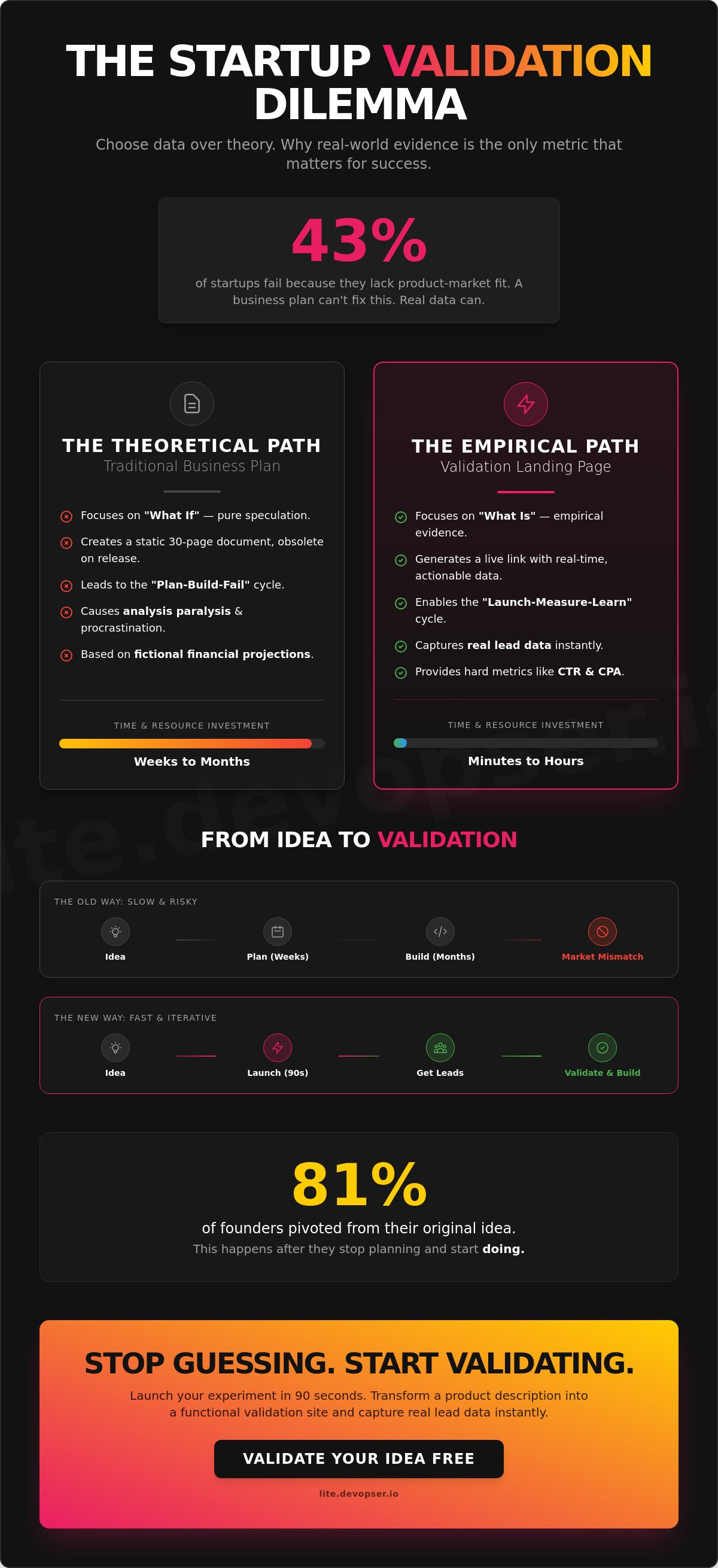
The Landing Page Advantage: Real Market Validation in 90 Seconds
Launch before lunch. In 2026, the winner of the business plan vs landing page for startup validation debate is the founder who moves the fastest. You don't need a finished product to start selling. You need a live link. Modern AI tools now handle the heavy lifting; allowing you to transform a basic concept into a functional, lead-capturing asset without writing a single line of code. This speed gives you access to real-world acquisition data immediately. You see exactly what it costs to get a visitor through your digital door. You aren't guessing a marketing budget in a spreadsheet; you're observing it in real-time.
Building the MVP (Minimum Viable Page)
Keep your validation experiment focused. A Minimum Viable Page only needs four elements: a strong hook, a clear value proposition, social proof, and a single call-to-action. You don't need a full website to test a single offer. Use forms that work without any configuration or plugins to capture lead intent the moment it happens. This setup removes the friction between a visitor's interest and your lead management dashboard. Focus on the offer; let the automation handle the rest.
Measuring What Matters
Conversion rates are the only metrics that prove your idea has legs. Use a full website analytics dashboard to turn visitor clicks into strategic decisions. Identify exactly where your real customers hang out by tracking traffic sources. If your conversion rate is high but your traffic is low, you have a scaling problem. If your traffic is high but your conversion is low, you have a product-market fit problem. Stop wondering and start measuring. The data will tell you exactly what to build next.
How to Use an AI Tool to Create a Business Plan (and Why You Should Launch First)
Efficiency is the goal. You can use AI to generate a lean business plan in minutes; not weeks. This shifts your focus from writing to executing. Start by prompting an AI to draft a core strategy based on your vision. It will produce an executive summary and financial framework instantly. Remember that this document is still a collection of assumptions. You must identify the "riskiest assumption" in your AI-generated plan immediately. Usually, it is the belief that customers actually want your solution.
Test that specific assumption with action. Build a landing page to see if your target audience responds. This is the practical application of the business plan vs landing page for startup validation debate. Once your page is live, collect interaction data. Feed these real-world results back into your AI tool to refine the original plan. This creates a living document backed by facts rather than a static paper based on hope. A data-driven plan is far more valuable to partners and investors.
The Role of AI Business Planning
The "Launch-First" Framework
Stop guessing your market size. A landing page is the best research tool for your business plan. It allows you to replace "estimated demand" with an "actual lead count" in your pitch deck. Investors in 2026 value traction over projections. Show them a list of verified leads instead of a spreadsheet of theoretical revenue. Turning validation data into a story creates instant credibility. Launch your validation experiment now to start collecting the evidence you need for a winning plan.
Launch Your Validation Experiment with DevOpser Lite
The debate between a business plan vs landing page for startup validation ends with action. You can now transform a basic text description into a high-converting page in 90 seconds. This is the most efficient path to market in 2026. You don't need a background in code. You don't need to hire expensive designers. Our AI handles the layout, the copy, and the visuals with machine-like precision. This removes the friction between your idea and your first customer interaction. It is a custom asset built to match your specific vision instantly.
Avoid the monthly subscription trap. Many tools lock your data behind recurring fees that drain your budget before you've made a sale. We believe you should pay once and own your validation asset forever. This ownership model allows you to run experiments without the pressure of a ticking clock. You get a professional presence that works for you 24/7. It includes integrated lead management so you can track your success from a single dashboard. Every click and signup is recorded with total transparency. You own the site; you own the data.
From Idea to Live Site in 20 Minutes
Data-Driven Growth for Solopreneurs
Turn your validation experiment into a growth engine. Use the built-in analytics dashboard to see real-time results. You can identify which hooks are working and which traffic sources are delivering the best leads. Managing your first 100 leads is effortless with the lead management dashboard. You don't need to learn a complex CRM or pay for external services. Everything is centralized for maximum efficiency. This allows you to iterate on your business model based on hard evidence rather than guesses. Launch your business now to stop planning and start growing with confidence.
Stop Planning and Start Validating
The debate is over. Theoretical planning cannot compete with empirical evidence. You've seen how traditional documents often fail the reality test. You know that landing pages provide the fastest path to market. In 2026; speed is your most valuable resource. Don't let analysis paralysis stall your progress while competitors capture your audience. Real-world interaction is the only metric that matters for your success.
Launch your business in 90 seconds with DevOpser Lite. Benefit from no-code AI generation and a pay-once ownership model. Your site includes AWS-powered hosting for maximum reliability. Stop drafting. Start selling. Your future customers are waiting for you to hit publish.
Frequently Asked Questions
Do I need a business plan if I have a landing page?
How can an AI tool help create a business plan?
AI automates the structural heavy lifting of documentation. It generates executive summaries, competitor analysis, and financial frameworks based on your specific prompts. This turns a week-long drafting process into a task that takes minutes. Use it to map out your strategy after your landing page proves there is a real market.
Can I validate a SaaS idea with just a landing page?
Yes. A landing page acts as a smoke test for your software concept. Present your core value proposition and a "Join the Waitlist" or "Get Early Access" call-to-action. If people provide their email addresses, you have validated demand. This is the core of the business plan vs landing page for startup validation approach.
How much does it cost to launch a validation landing page in 2026?
Costs vary depending on your hosting and domain requirements. Many modern tools offer free entry points to help you start your experiment without upfront investment. Focus on finding a solution that includes integrated forms and analytics to avoid paying for multiple external plugins. Research current market rates for domains to set your budget.
What is the difference between a landing page and a website?
A landing page has one goal: conversion. It removes distractions like navigation menus and external links to keep the user focused on a single offer. A website is a collection of pages that provides general information about a company. For validation, use a landing page to get clear, focused data on a specific idea.
How long does it take to get my first lead after launching?
You can see results in hours if you drive targeted traffic. Once you hit publish, your forms are live and ready to collect data immediately. The time to your first lead depends on your distribution strategy; such as social media posts or paid ads. Modern automation ensures you are notified the moment a lead arrives.
Is a landing page enough to get investors interested?
Why should I use AI instead of a traditional website builder like Wix?
AI prioritizes speed and automation over manual configuration. Traditional builders often require you to handle design, layout, and plugin setup yourself. AI handles the heavy lifting by generating a high-converting page from a text description in seconds. It allows you to focus on your business logic instead of fighting with a drag-and-drop interface.